-
Title
-
La Voz de Aztlan, May 13 1991
-
Creator
-
Associated Students of Fresno State
-
Relation
-
La Voz de Aztlan (Daily Collegian, California State University, Fresno)
-
Coverage
-
Fresno, California
-
Date
-
5/13/1991
-
Format
-
PDF
-
Identifier
-
SCUA_lvda_00197
-
extracted text
-
Volume
XXIII
Issue No. 3
Lavoz de Aztlan
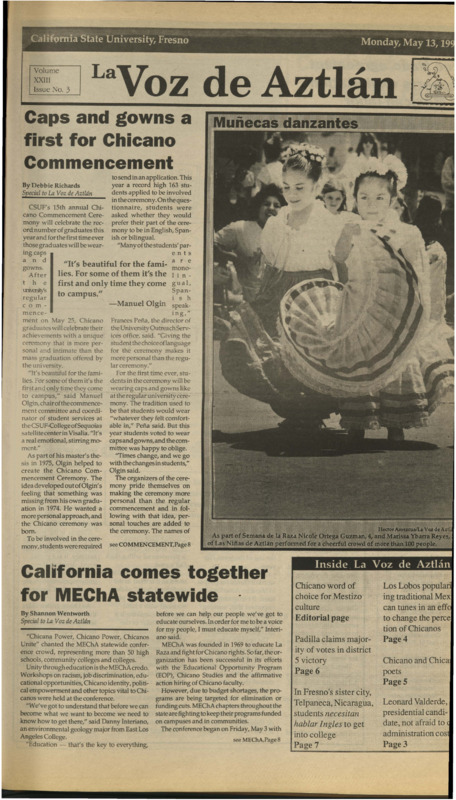
Caps and gowns a
first for Chicano
Commencement
to send in an application. This
year a record high 163 students applied to be involved
in the ceremony. On the quesCSUF's 15th annual Chi- tionnaire, students were
cano Commencement Cere- asked whether they would
mony will celebrate the rec- prefer their part of the cereord number of graduates this mony to be in English, Spanyear and for the first time ever ish or bilingual.
those graduates will be wear"Many of the students' paring caps
ents
a n d
r e
"It's beautiful for the fami- amonogowns.
lies. For some of them it's the I i n After
t h e
first and only time they come g ua I,
l.ll1Ml9ty's
Spanto campus."
regular
i s h
-Manuel Olgin speakCO m menceing,"
ment on May 25, Chicano Frances Pena, the director of
graduates will celebrate their the Univ~rsityOutreachServachievements with a unique ices office, said. "Giving the
ceremony that is more per- student the choiceoflanguage
sonal and intimate than the for the ceremony makes it
mass graduation offered by more personal than the reguthe university.
lar ceremony."
"It's beautiful for the famiFor the first time ever, stulies. For som e of them it's the dents in the ceremony will be
first and only time they come wearing caps and gowns like
to campus, " said Manuel attheregularuniversitycereOlgin, chair of thecommence- mony. The tradition used to
m en t committee and coordi- be that students would wear
nator of student services at "whatever they felt comfortthe CSUF-College of Sequoias able in," Pefia said. But this
satellitecenterin Visalia. ''It's year students voted to wear
a real emotional, stirring mo- capsandgowns,and thecomment."
mittee was happy to oblige.
As part of his master's the"Times change, and we go
sis in 1975, Olgin helped to with the changes in students,"
create the Chicano Com- Olgin said.
mencement Ceremony. The
The organizers of the cereidea developed out of Olgin' s mony pride themselves on
feeling that something was making the ceremony more
missing from his own gradu- personal than the regular
ation in 1974. He wanted a commencement and in (olmore personal approach, and lowing with that idea, perthe Chicano ceremony was sonal touches are added to
the ceremony. The names of
born.
To be involved in the ceremony, students were required see COMMEN CEMENT,Page 8
·.·.··.· ................. .,·:·· .-.. ,.. : : ·:· tu ., _-: .
·1
.
> J · · ., ··, ,r .'•.': \,.:. :>,. .>:::::::::>:.:. •:,..,..;.... . .::::,.,.,.,..''.;;:,-:
By Debbie Richards
Special to Ia Voz de Aztltin
ii
I
I
i
i;i;
,:.:,
ir
I
I
California comes together
for MEChA statewide
By Shannon Wentworth
Special to Ia Voz de Aztltin
before we can help our people we've got to
educate ourselves. In order for me to be a voice
for my people, I must educate myself," Interi"Chicana Power, Chicano Power, Chicanos ano said.
Unite" chanted the MEChA statewide conferMEChA was founded in 1969 to educate La
ence crowd, representing more than 50 high Raza and fight for Chicano rights. So far, the orschools, community colleges and colleges.
ganization has been successful in its efforts
UnitythrougheducationistheMEChAcredo. with the Educational Opportunity Program
Workshops on racism, job discrimination, edu- (EOP), Chicano Studies and the affirmative
cational opportunities, Chicano identity, politi- action hiring of Chicano faculty.
However, due to budget shortages, the procal empowerment and other topics vital to Chigrams are being targeted for elimination or
canos were held at the conference.
"We've got to understand that before we can funding cuts. MEChA chapters throughout the
become what we want to become we need to state are fighting to keep their programs funded
know how to get there," said Danny Interiano, on campuses and in communities.
The conference began on Friday, May 3 with
an environmental geology major from East Los
Angeles College.
see MEChA,Page 8
"Education - that's the key to everything,
Inside La Voz de Aztlan
.Chfoah:J:,-tG8rd\,f'
choice for Me~tizo .
culture
Editorial. page· .
· t\.>><t ,.''·· ·t;:.:/·/:J. :: :•:.//1··,:::;:/.
·:GOS · .L1Ou0.S ·POPU
'h1g tr;utitj.qnaf.M~x
can tunes'. in' an eft
td change··the })€free
tion of Chicanos .
Padilla claims majority of votes in:district
5 victory
Page4
Page6
poets
PageS
.·.: :·.
Chicano and Chica
In Fresno's ·sist~r city,
Telpaneca, ~k~agua, , Leonard Valderde,
presidential candi- .
students necesitan
date, not afraid to
hablar Ingles to get
administration cos
into college
Page7
Page3
�Monday, May 13, 1991
Voz de Aztlan
La
Free trade agreement
supports exploitation
of Mexican labor
Hector Amezcua
What will a "free trade
agreement," between Mexico,
the United States and Canada
really mean?
First of all it means that the
wealthy will be getting fatter
and the poor will slowly die of
hunger.
Mr. Salinas de Gortari,
President of Mexico, may be
having the greatest relationship
of any Mexican President with a
U.S. President. But, with his new
plan, will eventually rank as
Mexico's worst president.
There are many things that
Gortari is doesn't want to admit,
like the fact that the people living in Mexico will become slaves
to American corporations.
Already in Mexico, companies
such as Green Giant have set up
plantations and exploited the
Mexican people.
·•
. -·
.··.· .. ·
Child labor is abundant in
many regions of Mexico. Many
of these children suffer as a
result of rare diseases caused by
polluted waters and malnutrition.
What is this free trade going to
do for them? Create better health
services or pollute the waters
more?
Worst of all the companies
who will be moving to Mexico
will be paying workers miserable salaries without providing
medical benefits.
According to Jorge Castaneda,
an expert on Mexican policy,
Mexican workers earn about $1
an hour without benefits.
In the U.S., workers make up
to seven times as much for the
same work.
Although the cost of living in
Mexico cannot be compared to
that of the U.S., it is cheaper to
see TRADE, Page 7
Editorial
2
\ £STA S\ QO~
'1A AE:S,AR
DURA ,I
f'4\~C~QO
COf\4\\JN
4t a
cO
r,
0
Wr
I
.
,
"
'/
I
!
I
.
I I;
I
//(JJ~
0
..... .....
_
. id.i(lfJt:,:i.J~J'.; ;
!lfllllll
=:.,-: ij~~:I~t:m1i¢1~r
1
::1t::Ii::::::I::::::11i:1i !i!
La V< >Z de AztLin
Editor
Hector Amezcua
Assistant Editor
Virginia Adame
Copy Editor
Shannon Wentworth
Poetry Editor
Daniel Chacon
Staff Writers
Cristina Medina
Joe M. Torres
Cartoonist
Erik Vallejo
Contributors
Jana Ballinger
Debbie Richards
Thor Swift
Anastasia Hendrix
Andy Davey
©La Voz de Aztlan 91
Chicano not Hispanic
JOE TORRES
As a small Mexican
boy being raised in the
valley, wondering what
or who I was always
baffled me. Relatives
would call me Mexican
or Mexican American
while my teachers and
peers in elementary
school referred to me as
American.
This created confusion
as I grew older. I really
began to question my
own identity. I hoped
this could be cleared up
when I entered Fresno
City College.
This only served to
mix me up more. I heard
words like Spanish,
Italian, and even Hawaiian and Somalian. But,
as I first began hearing
words like Chicano and
Hispanic, I wondered if
those terms applied to
me.
At first the word
Chicano was not the
word of choice for me. It
seemed kind of wrong
to use a word meaning
small boy or small man.
I couldn't identify with
the word.
Then, I t~ok a course;
Chicano-Latino Studies
3. hhought this would
answer the question I
have been asking myself
for over 22 years. Who
am I? Chicano, Latino or
Mexican-American?
The more I was fused
in an atomsphere stressing
the word Chicano, the
more I truly felt it should
be used to identify the
mestizo class of people.
The word creates a sense
of pride and of belonging
to a mainstream culture.
On the other side of the
coin, Hispanic is a word
creating more illusion than
reality. Truly mindful
people of the Chicano cul-
These were the first Hispanics.
The term Hispanic was
used to identify numerous
Cubans and Puerto Ricans.
The term, coined through
the news media, became a
convenient tag and appliedto all people south of
the border.Apparently, it
became easier to stomach.
Chicano has a certain
ring to it. Chicano is pro-
It is a proud word, denoting
three centuries of torment and
underrepresentation endured
by the Chicano people.
ture really demean themselves by succumbing to
the use of the word Hispanic.
Chicano should be the
word of choice for people
of Mexican American descent. It recognizes an
important trait, unrecognized in people either of
Mexican or Latin American descent, Indianismo.
The Spanish who conquered Mexico in the 16th
century mixed with the
Aztec Indians and other
Indian nations. This
created the mestizo class
of people - the Chicanos.
The term Hispanic originated in the area of Sante
Fe, New Mexico (San Juan
de Caballeros). Founded
in1598 by Juan de Onate.
nounced with a thick
"Chi" and the "cano" part
is pronounced with a thick
"k" sound.
The enunciation of this
word as it is used in the
traditional "calo" of the
street barrio will be pronounced with a hardedgedtone,makingita
bitter reminder of the
oppressed conditions in
which the majority of the
Chicano people live.
The simple harsh sound
derived from this word
comes out of an ignorance
of Chicano culture. It
comes for a mere stereotype derived from the
vague use of the term
Hispanic. This is simply a
misunderstood concept.
The word used to de-
scribe IIA PEOPLE"
should connect with the
people. In terms of endeannent of the struggle,
representing the reality
of the people. The word
Hispanic forgets the true
struggles and suffering
that many Chicano
people have to endure.
Every time Hispanic is
used in place of Chicano•
-denoting the mestizo
culture- it has an abrasive and demeaning
effect, damaging the true
plight of the Chicano
community. It is the
unhealing scar on the
face of an already oppressed nation of people.
Chicano is the word
that best describes those
with Spanish and Indian
heritage. It is a proud
word, denoting three
centuries of torment and
underrepresentation endured by the Chicano
people.
As I have grown older
the term Chicano, along
with another familiar
term, Aztlan -referring
to the land stolen from
my people- have made
me proud of my heritage.
I have come to accept my
Indianismo heritage, although it is unlikely I
will ever know the lineage of Indian people I
come from. I am proud
to be Indian nonetheless.
The word is Chicano or
Chicana. Use it.
�Candidate
diversity resul
of committee
By Jana Ballinger
Special to La Vaz
. .
Hector Amezcua/La Voz de Aztlan
Orig1anally from East Los Angeles Leonard Valverde hopes to make some positive
changes to the CSUF campus if selected as the school's president.
Valverde visits CSUF
By Virginia Adame
La Voz Staff Writer
Faculty involvement and
participation are extremely
im portant components of
universities.
Dr. Leonard Valverde,
presidential candidate,
stressed this point at a faculty question and answer
session during his May 1 visit.
The meeting was intended to
allow the ~faculty to get to
know Valverde and find out
if he is the most qualified
candidate for president of
CSU, Fresno.
The difference between a
good u_niversity and an outstanding university is faculty,
Valverde said.
"The heart, soul and guts
of aninstitution-its reputation - is vested in its faculty."
Valverde, regardless of his
position, still considers himself a faculty member.
The question of research
interfering with teaching
came up. Valverde said he
doesn't believe that a professor has to limit his specialization to one area, but can excel
in both teaching and research.
The' new president will be
facing a decreased budget with
this in mind Valverde said he
would work to reduce the deficit. However, he emphasized
that academic programs would
be the last cut.
Valverde did not hesitate to
say that he would be willing to
make administrative cu ts if the
need arose. He said that the
administration is a support
service.
Administrators have to be
scrutinized to determine
whether or not they are making an academic contribution
if not, then the appropriate
steps should be taken, he said.
In addition to faculty and
budget questions, curriculum
changes were discussed.
Valverde said he wants to build
a curriculum based on knowledge and information. He
stressed the importance of getting individuals to be functional, independent, and think
on their own.
"I don't think you can build a
curriculum based on knowledge, you would build a curriculum based on pedagogy,
instruction and confidence in
skill knowledge; a person can
read many different things,"
said Valverde.
Valverde said that the
Euro-centric curriculum used
now needs to be incorporated
with other bodies of knowledge.
With the strong ethnic diversity prevalent in the university system, we have to
incorporate Euro-centric curriculum and global curriculum, he said.
He also believes that students should be able to interact with the president of any
university. Valverde said that
the students and the president should be able to meet
for lunch or for an informal
get together at the president's
house. He would like to be
able to discuss issues that are
of concern to students with
students.
On a final note, Valverde
discussed the consequences
of a UC campus in Fresno.
Valverde said that students
still have a choice. They decide where they want to go.
"I was raised in Los Angeles. We had a saying - you
want a degree go to UCLA, if
you want an education go to
Cal State L.A.," said
Valverde.
As far as Chicano Latino
Studies Department Chair Dr.
William Flores is concerned, the
diverse pool of candidates that
the trustees has to choose from
is a direct result of the Committee for Hispanic Educational
Equity's struggles.
The five finalists included
one Chicano, Leonard A.
Valverde, and two African
Americans. Two of the five
candidates have dropped out;
only Carol D. Surles, John D.
Welty and Valverde remain.
The new president will be
chosen on Mayl3.
The Committee for Hispanic
Educational Equi tywas formed
in thefalloflast year.Members
include faculty, staff and stud ents from CSUF and Fresno
City College p lus various
community leaders.
"I think 1t [the committeetis
gomg to have a profou nd effect," said Flores. "It alreadv
has. It 1s going to change a lot i~
terms of ultimately who is selected."
In December of 1990 the
committee requested that the
trustees appoint a Chicano to
the presidential search committee. When that didn't happen,
they called for the committee
to abort the search. Representatives protested in Long Beach;
the result was the addition of
two hispanics to the process.
Ralph Pasqueira was named
a trustee and Manuel Lopez
was appointed to the Presidential Selection Advisory Committee. In addition, the search
was extended.
Two Chicanos were u ltimately chosen asserni-finalists·
one of the final three candidates is Chicano.
"Obviously, there were sen ous problems in the p rocess,"
said Flores. "They should have
[appointed a Chicano to the
committee] sooner and taken
an affirmative position instead
of having to be forced."
The committee is currently
working on legislation th at
would ensure Chicano representation on all committees
throughout the CSU system.
The purpose of this legislation, said Flores, is to improve
the representation of Chicanos
in all areas of higher education.
This is the first time that there
was any sustained effort to
change the search process.
"Clearly, they [the trustees J
now recognize tharthey cannot have one out of 21 ~ollege
presidents be Chicano," said
nores.
There are no Chicano nee
p residents and onlv two assistant vice president; m the CSU
system, out of all the tenured
faculty in the CSU system onlv
three percent are Chicano; thi-s
does not reflect the demographic make up of California,
he said.
Legislation has been introduced to require that the trusSee COMMITTEE, page 7
Castaneda makes
case for workers
By Debbie Richards
"the people," Castaneda emphasized the toll the new trade
agreement would have on
Jorge Castaneda impressed Mexican workers.
the campus community reTheagreementisanewtwist
cently with a lecture berating in relations between the U.S.,
the Mexican government for Canada and Mexico. It allow~
its unquestioning support of a for free trade between the three
free-trade bill between Mexico, countries and is considered
the United States and Canada. revolutionary in form and naCastaneda said the free trade ture.
agreement will come at a cost,
Castaneda, a professor of
and that cost is workers.
politicalscienceattheNational
"What is he [president Car- Autonomous University of
los Salinas de Gortari] selling Mexico, is a world-renowned
to investors? Well, he is essen- scholar and author. He has
tially selling investors - and advised the Mexican governlet's be perfectly frank about mentoninternationalaffairsin
this - he's selling cheap la- the past and is considered one
bor," Castaneda said. "That's of the foremost experts on
what Mexico is selling. I don't Mexican government and polthink it's the greatest thing in-- icy.
the world to sell."
Castaneda argued that the
Castaneda spoke as part of Mexican goverment is signing
the University Lecture Series. theagreementwithoutconsidHis talk came at the start of eringtheworkers,and without
Semana de la Raza. Fitting in
See CASTANEDA page 7
with the theme of celebrating
Special to La Voz
�i\londay, l\,Iay 13. 1991
La Voz de Aztlan
4
Hector Amezcua/La Voz de Aztlan
Los Lobos' energetic May 3 performance at CSUF capped off Semana de la
Raza's festivities. Louie Perez-drummer, singer and lyricist-said the band's
By Jill Soltero
Special to La V oz
The wolves were in full force at
CSUF on May 3.
Los Lobos, the renowned Chicano
folkloric and rock band from East
Los Angeles, performed in the Satellite Student Union before a cheering,
dancing crowd of 700 people. The
event concluded the Semana de la
Raza festivities this year.
The concert's repertoire focused
heavily on their latest album, "The
Neighborhood", in addition to
songs from past albums.
In an interview with La Voz after
the show, Los Lobos drummer
Louie Perez said the band's visit to
CSUF was their first. Perez said he
was impressed with the audience
and felt "a vibe going on" because
their performance coincided with
the Cinco de Mayo weekend.
The five-member band formed in
1974. Its members include Steve
Berlin, saxophonist; Conrad Lozano,
bassist; Cesar Rosas, vocalist-guitarist; David Hidalgo, vocalist, guitarist and lyricist; and Perez, guitarist,
drummer and lyricist. All but Berlin
have known each other since high
school.
Perez said when Los Lobos first
formed, its main objective was to
reflect the band's Mexican heritage.
''We formed Los Lobos as a group
that was trying to preserve Mexican
culture," he said.
The group began performing in Los
Angeles, where they played exclusively Mexican music for almost 10
years.
.
Perez said they were "expioring
more of the exotic regional music huastecos, stuff from Veracruz and
Guerrero. In doing so, because the
music varies from region to region
as far as instrumentation, we managed to collect 30, 40 different instruments.
"And over a period of 10 years, we
taught ourselves how to play [the instruments]. We made our way back
to rock and roll during the late '70s ...
when the new music movement was
happening in Hollywood. At that
time, we were exploring Tex-Mex
nortefio music," Perez said.
Subsequently, the group began
playing in Hollywood nightclubs and
also began receiving local music
reviews of their performances.
Success began to slowly unfold for
the band.
"First was the critical acclaim. Then
record company people started to
come out to see us and we eventually
ended up with a recording contract in
1983." The band put out their first
album titled "And A Time to Dance"
that year.
Although their first recording effort
was done on a "shoestring" budget,
Perez said the album was an important milestone for the Chicano music
scene.
"It caught everyone by surprise
because Chicano bands hadn't really
done much since ... [the Chicano
band] Tierra. Even though we didn't
have a hit song off of that record,
visit to CSUF was their first. Perez said he was impressed with the audience
and felt "a good vibe going on."
point. Our reaction to that was to put
out a record of Mexican folk music ....
"La Pistola y El Corazon" came out in
the fall of 1988. It was a record of
regional folk music; we kind of went
back to our roots after the big hit
·
song.
"We wanted to do something that
was more artistically rewarding for
us, and at the same time, almost a
social statement.
"It was a record of Mexican music,
that at that point- because of our
visibility- was available all over the
world ... so we had huasteco music
playing in Tokyo, Norway; so it's a
pretty heavy thing. We exploited our
visibility in order to do something
there was a certain climate for new
that
we felt was constructive."
music at that time. We toured all over
Since
their successful breakthrough
the United States ... in different places
into the mainstream music scene,
like Vermont ... places where there's
Perez said Los Lobos has made an
no Chicanos at all, way down south
effort to redefine the media portrayal
in North Carolina, Atlanta, Ga ...." he
of Chicanos.
said. By 1985, they had traveled all
· "If I can just step out of my role ...
over the world.
and look at this group objectively, I
Perez said "And A Time to Dance"
think we've made some pretty major
ended up on the Top 10 list nationchanges in contemporary music,
ally, from "the Village Voice in New
which is a pretty heavy thing to say,
York, to Rolling Stone magazine ... L.
_but
it's true.
A. Weekly, and a lot of different
"We're
the first Mexican American
magazines."
band
to
really
do what we've done
The group reached a milestone in
and
still
not
flag
wave and portray
1984 when they won a Grammy
ourselves
as
a
microcosm
of some
award, under the category Best
exotic
culture,
but
as
...
part
of the big
Mexican American Performance, for a
picture
in
this
world.
We're
just
traditional song entitled "Anselma."
Several years later, Los Lobos burst redefining [and] educating people.
into the mainstream music scene with We've opened some doors for Latin
music in the past three or four years."
their soundtrack to the 1987 movie
Plans for Los Lobos include partici"La Bamba." Perez said the impact of
pating in national festivals through
the famous song was global.
August. Prior to their CSUF show,
"A lot of people would trivialize it
they had performed in a jazz festival
as just a novelty song. [But] for that
in New Orleans. They will hold
summer in 1987, we had people all
shows in Jackson, Miss. and Philadelover the world singing the Spanish
phia.
They will also perform in New
lyrics to a song that was 150-yearsYork
City's
Central Park and Vienna,
old. I think that's a pretty heavy
Va.
•
thing," he said.
Perez said the band's next album
The "La Bamba" soundtrack
should
be out by the beginning of
changed Los Lobos' future.
next year.
''We became very visible at that
�Monday, May 13, 1991
La Voz de Aztlan
NOWHERE TO BE FOUND
He works and does
not have the
tolerance
to be there for me
nor understand
what
iam
going through
iam
going to fall
Who is going
to catch me
r.....
when
i collapse
from this
miserable life?
Weak as i am
i could just
press myself
to the
earth and plunge
down into my own grave,
let her swallow
my foetus and keep it
warm for his supper.
....
Ballad Of What The Wind Said
• G.
{)
CJ
,,
Eternity could easily
be only a river,
a forgotten horse
and the cooing
of a lost dove.
As soon as a man loses touch
with other men, the wind comes
· · and tells him other things,
opens his ears
and his eyes to other things.
Today I distanced myself from other men,
and alone, in this gully,
·
o
. I saw only a horse
:;; , and listened only
. · to the cooing
of a lost dove.
()
_./!.~ q
. ,~t
And then the wind came near,
just like someone passing by,
and told me:
Eternity could easily
·be only a river,
a forgotten horse
and the cooing
of a lost dove.
()
by Lucia Sanchez
by Rafael Alberti
translated by Julio Leal
WHY
Their bond breaks
his mind
separated
from emotions
shine from the ceil_ing
He couldn't
stand the
pain
up fast,
down hard,
long, like lightning
licking you
into a state of dreams
No resolution
coke induced
decision
where wasps
tickle your ear
lovingly,
The hammer
falls
twice
rrraka takka
boom
then sting
your stomach
until swollen
1ike a big taut ball.
there they
lie
two
spirits
rise
5
0
---
(,
C
When you wake,
i will be next to you,
the stars will
shine from the ceiling
and our bodies, wet,
will glisten
under their light.
!fl
by Sam A. Gill
l
•
by Andres Montoya
For the record:
La Voz de Aztlan would like
to apologize for miscrediting
the coverdrawingof the April
29 insert. The drawing was by
Luis Ramirez, not Jose Rodriguez.
�6
La Voz de Aztlan
Monday, lVIay 13, 1991
Community ties Padilla to
Fresno Chicano interests
• CSUF graduate hopes to
Padilla becomes
first Chicana
council member
• Grass roots ca1npaign
key to her success
maintain ties to community
By Joe M. Torres
I.a Vaz Staff Writer
By Joe M. Torres
I.a Voz Staff Writer
Esther Padilla, 5th district candidate, wants to take
campaigning to a grass roots level.
Esther Padilla graduated from CSU, Fresno in 1966
with a bachelor's degree in social work. At the time,
there were "not very many Chicano students at the
university/' said Padilla.
Padilla has always felt the need to keep in touch
with the Chicano community.
Working through "Centro la Familia," Padilla has
put her efforts into the service of the Chicano commuru ty. "I worked in the community like a public servant working in the community with families, children, and youth." Padilla returned to the university
in the early 80s to get her master's degree in social
work.
Padilla's father who was a farmworker didn't want
to see Padilla working in the same environment. ''He
didn' t want to see us working in the same ind us try ...
he was very adamant. It was a real effort in terms of
our tamily ."
Community interaction is the goal of Padilla's
ampaign. "This campaign has been real grassroots,"
.. e said. The mainstays of her campaign are mailing
:md door to door.
One of her goals is to rebuild community manageent. "Schools are gomg back into site based management/' said Padilla. She wants schools restructured to involve parents and students in the educational process.
Another key element of Padilla's campaign is concern for the community's condition. Incidents of
violence, drugs and gangs have prompted concern in
the southeast community.
The environment is one of Padilla's target areas.
"Southeast Fresno need.snot to be a dumping ground,"
she said.
Approaching the campaign as a Chicana woman
brought Padilla a better perspective on the community.
Padilla feels there is a challenge to confront. "As a
woman, it sets into being a role model for young
people." Padilla said,
"The next person coming through will not have to
break those barriers."
Padilla stresses college and education as assets in
the community. Her message is learn and be openminded.
"Get your college education, complete it."
At 10:18 p.m. on May 6Ester Padilla defeated
Chris Peterson to become the first Chicana councilmember.
She won the 5th district post with 3,331 votes,
more than half of the majority. Padilla took 55.7
percent of the vote compared to 44.1 percent for
Peterson.
There are several key issues facing Padilla as
she prepares to serve on City Council. Padilla
plans to bring a traditional role to the council,
serving as a politician and continuing to work as
a social worker. The incumbent Chris Petersen
had served on the council for the past eight years.
Padilla is the third Hispanic and the fifth woman
.---.
Virginia Adame/La Voz de Aztlan
Esther Padilla became the first Chicana city council member of Fresno after last week's elections.
Padilla said, "Try to be as open-minded as possible
... listen, hear and dialogue and respect the qualitie::,
that people have."
The key to Padilla's campaign is making people
realize that change is needed. A change stressing
community involvement in political processes.
Padilla's ability to bring people together has been
the key to her success. Padillas said, "one of the
elements is to bring people together. This race has
allowed me that challenge."
I think the city of Fresno has spoken.
They want a change at city hall, they
don't want to accept the way things
have been taken care of in the past
-Esther Padilla
on the city council.
Her successful bid for councilmember was a
result of many long months of hard work.
The key to the success of Padilla's campaign
was grass roots activism, utilizing an absentee
ballot campaign which significantly increased the
number of voters.
Padilla said, "we encouraged people to vote absentee because it was the only thing on the ballot
and it seemed like the sensitive thing to do."
Padilla said, "I think the city of Fresno has
spoken. They want a change at city hall, they don't
want to accept the way things have been taken
care of in the past and we want to move forward
in a very positive way and be able to be inclusive
of this very diverse community that we have."
Padilla and her husband Gilbert Padilla were
involved in the United Farm Workers Union. She
served as president of the Mexican-American
Political Association. Padilla is also one of the
founding members of Fresno Tomorrow which
helps at-risk of failing elementary school students.
One of the key issues she will start on is repealing the council's pay increase.
CH.O.breaks language barriers for patients
By Cristina Medina
I.aVoz de Aztlan
Christina DeContreras believes that the needs of
people of color are being over
looked in the health field. ··
As president of the Chicano
Health Organization at CSUF,
she hopes the club's efforts will
attract students with similar
concerns.
"Sometimes, because of language barriers, minorities are
not able to get sufficient care.
With more minorities in the
health field, we can relate and
care for those people and help
to make a better society," DeContreras said.
• Organization recruits students who believe
they can make a differ(}nce in community
The Chicano Health Organization (CHO) has been at CSUF
for more than 15 years. It offers
a support system for students
pursuing careers in health sciences. Its priority is offering
services to the community.
'We like the community to
know who we are. We want to
bring the students from the
university and the people from
the community together. One
way is by going to the high
schools and talking to students
about health related issues,
subjects like diseases and
AIDS," DeContreras said.
In recent years, the club has
brought speakers from the science community to campus.
The club is also responsible for
for organizing free, bilingual
CPR classes.
'We established a fund to
offer free one-day CPR instruction. It's important that people
have the opportunity to take
part," DeContreras said. "Last
year, we went to a church and
took the blood pressure of the
people. Those are just some of
the things we do to help out."
DeContreras, a senior zoology major, said the club is always interested in new members and is currently trying to
get more students involved in
the club's activities.
"Many of our core people
have graduated. Weare trying
to recruit people who believe
that, as students, we can make
a difference," DeContreras
said.
"As minorities, it is impor-
tant to know where your roots
are from and be able to go back
and help our community and
families."
In collaboration with the
HCOP program, CHO brought
Dr. Hector Florez, president of
the Chicano-Latino Medical
Association of California, to
CSUF on Monday, March 18.
Florez' s efforts, in support
of legislation for better health
care, have been recognized nationally. His presentation was
titled "Pluralistic Society; Minorities Working Together for
Better Health Care."
�.Ivionday, May 13, 1991
La Voz de Aztlan
7
Nicaraguan sister city fights for education
Hector Amezcua
La Voz de Aztltin
"This project will remedy a very
difficult problem thatwearegoing
through- especially in the intellectual field-because there isn't
enough consultation material."
During a meeting with President Harold Haak, Gomez explained the need to have someone
from T.elpaneca educated in
Fresno.
'Wewouldliketoseeifwecould
have one or a few sh,J.dents teaching English, or if possible bring a
student from Telpaneca so we
could have a permanent English
teacher," Gomez said.
Haak said he would assist
Gomez in his search for someone
to teach English.
Although Telpaneca receives
help from many other countries,
Gomez feels that Fresno is the
greatest supporter.
"One of the [cities] that is supporting us the most with material
and economic resources, is precisely the community of Fresno,"
Gomez said.
While public education is taken
for granted in Fresno, the people
of Fresno's sister city Telpaneca,
Nicaragua have given their lives
in the fight for education.
During a two week visit, Ramon
Gomez, a city council member and
former mayor of Telpaneca, expressed appreciation to the people
of Fresno for their support of sister
city Telpaneca.
In 1989, the Fresno Sister City
Council built a school that 98 children from the Telpaneca farming
community attend.
''I'm visiting Fresno because of
an invitation from the Fresno[/
Telpaneca]SisterCityCouncil.An
invitation that I consider very important.
"For us, it is very extraordinary
that people from other places see
the necessities in our nation, and
basically they put their focus on
our city ofTelpaneca," Gomez said.
Educating Telpaneca
Gomez, himself a teacher, explained the need to have students
from Fresno teach young children
how to r~d and write English.
"We've been speaking to students, and there is a lot of concern
about the situation in Nicaragua.
"We need one student to teach
English in high school, and that is
something that has motivated a
few people," Gomez said.
La Voz de Aztlan
Sandinistas Misun-
According to Ramon Gomez of Telpaneca, Fresno's sister derstood
city in Nicaragua, it is in the process with the current
Gomez explained that the confusion surrounding Sandinistas
governemnt to increase their education budget.
In Nicaragua, English is a requirement for students seeking
higher education.
The construction of a library in
Telpaneca was another reason for
Gomez's visit. He hoped to raise
somemoneyforitsconstructionin
July.
''We now have a project of building a public library, that basically
will serve as a medium to continue
expanding the services of education," Gomez said.
makes people hesitant to help.
In July of 1979, the people of
Nicaragua managed to overthrough the dictatorship of the Somoza family, which had ruled for
more than 43 years.
The Sandinistas took over the
government and began a movement toward democracy.
Although Gomez is a member
of theSandinistas, he does not represent them in city council.
'What we do in the municipal
govemrnentis not representing the
Sandinista front, but instead what
we do is lift and push the development of the community not as
parties, but asa municipal organization that has to respond to the
basic needs of it's people," Gomez
said.
"Outside of Nicaragua it is
thought that the Sandinistas are
warriors, communist, marxist."
''The real truth is thattheSandinistas have pledged to assure a
democratic process in Nicaragua
and to actuate its development,"
Gomez said.
"I hope that the community of
Fresno has clearer ideas than they
had before about the concept of
what a Sandinista is.
"The real situation is that there
isn't a co-government or that the
Sandinistas don't have any contact with the government to govern, but instead they are helping
to support the reconsbuction of
the country, and in that way we
are trying to show people that it's
not the way they see it on television or the way they read about it
in newspapers.
''What we are trying to do is
consolidate the conquests that
we've made and help the government in which ever way we can."
McDonald's seeks Chicano employees
La VozStaff
Awarethatnearlyhalfitscustornerbase
in the Fresno area is Chicano, the
McDonald's Corporation is encouraging
Chicanostojoinitslocalmanagernentranks.
Olga Molina-Mares, a CSUF graduate
now living and working in Sacramento as a
personnel supervisor for the fast food hamburger chain, was in town last week for a
I M D ald
:ro:.ia c on 'smanagertrainingsesShe visited campus to finalize plans for
McDonald's sponsorship of the Chicano
JournalismStudentsAssociationrnagazine,
Destinos.
She also prornoted the McDonalds' Internship Program whichprovidesmanagement training to students while they comlete their college educations.
P
Molina-Mares is seeking Chicano stu-
den ts for the program. The program places
·
•
· th e
co11 ege JUniors
an d seniors
m
.
McDonald'sRestaurant Management Traming Program at entry level manager trainee
Positions.
''Th
.
.
$l
ti
e tramee receives a , 000 annua1s pend toward college expenses," Mares said.
''Th
.
k
. .
e tramee can a1so wor a rn1rumum 20
hour week at $8.15 per hour•"
Frornmanagertrainee,withasalaryrano-e
o
of $17,CXXJ to $20,000, the participant may
clirnbtheMcDonald'smanagernentladder
uptostorernanagerwhich pays from $27,CXX)
$41 CXX)
to
, .
McDonald's also offers its interns cornpany benefits, such as health insurance,
stockpurchaseplan,profitsharingand paid
.
M lin M
.d
vacations, o a- aressai .
·
A 1976 CSUF gra d uate Wl'th a d egree m
psychology,Molina-Mares worked her way
. the
up the company ladder b y entenng
training program in 1983. She managed her
own restaurant for two and one half years
before accepting the promotion to personnel.
In ~ddition to seeking Chicanos for the
~
internship program, McDonald's has supported CJSA's Destinos magazine for three
years by sponsoring its past Chicano Youth
Conference and Chicano Commencement
Celebration1·ssues.
Destinos is published twice a year and
CJSA Advisor Torn Uribes says that
McDonald's support has been crucial in
allowing CJSA to provide quality publications.
Molina-Mares said McDonald's will continue to support these CSUF activities and
she encourages Chicano students to take
advantage of the internship program.
McDonald's not only seeks business stud ents, but stud ents from oth er discrp
. lines
as well.
"For motivated individuals, the possibilitiesarevirtuallylimitless," she said. ''The
M
entire anagement Training Program is
d · d tO
l
th I dd
eSigne
move peop e up e a· er as
quickly as their performance merits."
She said students have the opportunity to
learnasmuchas theywantaboutallaspects
of the business - real estate, finance, accounting and marketing.
"At M Do Id'
h
th bTt t
c na s you ave ea 11 Y O
createyourowndestiny,"shesaid. "It'sall
here and management encourages and supports your desire to learn and move up in
the company."
Students may obtain information about
the program by calling Uribes at 278-5366
and leaving a mailing address, or by writing to the McDonald's Corporation, FerI D artrn t 1750 H
A
Sso~eSSO eSap
en 1 Ca 9So8w25e venue,
wte
, cramento, .
D~spite budget cuts UMS moves forward
By Hector Amezcua
La Voz de Aztltin
Migrant students in 1981
were given the opportunity to
break from thetraditionalfannworking role by a federally
funded assistance program
aimed at keeping migrant
:::❖:•:•:• · ··
·:·:-:-:,:;::::.:·•·::::::::
youths out of the fields and financial concerns led the
gettingthemintotheclas.sroom CAMPstafftobeincorporated
into the university. "When
· £ed alfu di
1ostlts
CAMP
The College Assistance Mier
n ng,
grant Program (CAMP), now we had to decide whether we
called University Migrant Serv- would close down the services
ices (UMS), was formed to that CAMP was providing,"
assist students with the transi- sa1'd corcoran.
"I made the decision that the
tion from high school to colactivities
directed at migrant
lege and help fill the needs of
studentsweretooimportantto
migrant students at CSUF.
A funding proposal for the end. So we absorbed the staff
d
CAMP program was written that CAMP was carrying an
for the U.S. Department of we established UMS," CorcoEducation by Raul Diaz, UMS ran said.
director, and Raul Moreno,
UMScounselor,BonniePickUMS counselor. Although the ett,said,"wehadalotofstrong
program initially received supportfromthedean'soffice
support, CAMP has had to because he thought we were
make many changes due to very effective in recruiting and
fundingcutsthatbeganin 1986. retaining students from miAccording to William Corco- grant and seasonal farmworkran, dean of student affairs, ing families."
With help from Corcoran,
CAMPreceivedastategrantin
1987 and changed its name to
UMS
·
Despite budget concerns,
UMS has continued to serve
the need of migrant students.
"Because of documents
needed to qualify for financial
aid, more and more students
are forced to drop out of lhe
university. Therefore, there is
agreaterneed to help students
more and more," Moreno said.
The programs success, according to Moreno, is due to
the personal attention the students receive in a family atmosphere.
In addition to problems
adapting to the stresses of college,somestudentsexperience
stress problems because they
were excluded from legaliza-
tionby the 1986 AmnestyLaw.
Counse~ors are usually able
to help Wlth problems. However, according to Moreno,
when they can't help students
are referred to som~ne who
specializes in the area of concem.
Diaz and Moreno instigated
the migrant assistance program
inhopesofendingorlessening
personalandeducationalworries.
"We saw a growing number
of migrant students at this
university who needed help,"
said Moreno.
Morenodeclined to give the
names of students with this
pro~l~mbecauseoftheissue's
sensitive nature.
"I feel that there are a lot of
people who would react negatively abo:utourstudents' problems," said Moreqo.
'
�.
Monday, May 13, 1991
MEChA
• Continued from page 1
a "cultural night" that consisted of
poetry readings by Juan Felipe
Herrera, Margarita Robles and
Jorge Reynoso followed by "El
Soldado Razo" a play by Ruben
Fuentes. Ballet Folklorico de
Dinuba capped off the night of
Chicano culture.
EarlySaturdaymorningtheconference participants assembled in
the Satellite Student Union to hear
•Continued from page 3
tees select a presidential selection advisory committee that "fully encompasses the diversity" and ethnic composition of theparticularuniversity's
service area.
CSUF' s service area is 40 percent
Chicano and 19.8 percent of the student body is Chicano.
"That [legislation] was something
that was initiated here," Flores said.
If the legislation passes, all other
universities would have to follow
these guidelines
"We are trying to restore fairness to
Commencement
• Continued from page 1
each graduate are called, along
with the parents' names, hometown, high school and career
goals. The students and their
parents are included in the
graduating process.
After the ceremony,· there
will be a reception followed by
mariachis in The Bucket. The
organizers said it's a chance for
everyone to celebrate the accomplishments of -those
who've graduated.
"It's just a very nice thing,"
Olgin said. 'We like to do this,
we really like to do this."
La Voz de Aztlan
"I thought the workshops went
guest speakers Arturo Rodriguez
from United Farm Workers, Dr. very smoothly, I was very imWilliam Flores, chair of Chicano pressed with the information preand Latin American Studies de- sented," said Claudia Soria, a stupartment and Ben Benavidez, dent from Kings River CommuPresident of State and National nity College.
In addition to hamburgers and
Mexican-American Political Association.
Pepsi, the conference participants
The participants then chose to were treated to the music of Maattend one of the nine workshops rimba de la Pena during lunch.
offered. Two sessions of work- The music was followed by a
shops were held, one before lunch speechfromaformernun wishing
and one after.
to be known as the "woman who
Committee
the process," said Flores.
He believes that Valverde "has a
very good shot'' at being chosen to
replace president Harold Haak.
"It is clear that the trustees are looking for someone who is a good manager and is willing to make cuts,"
Flores said.
"Valverde has a good track record," he said."As far as whether they
will hire him, I don't know."
It is important for the new president to be committed to affirmative
action, faculty diversity programs and
educationalequityprogramsinaddition to being sensitive to the needs of
the rapidly growing Chicano population at CSUF, said Flores.
Spanish
Castaneda
•Continued from page 3
regard for the welfare of those workers.
"Mexico will sign anything. It makes
no sense to sign agreements without
any teeth in them," he said. "[This agreement] makes no sense. It makes no sense
to negotiate a free-trade agreement and
leave out workers."
Castaneda discussed the "cheap labor" pool in Mexico and said the agreement gives Mexico an opportunity to
exploit that labor. He compared the
earnings of a Mexican worker to that of
an American worker to demonstrate
the way that American corporations
moving into Mexico will be able to
exploit the Mexican worker.
In Mexico, Castaneda said, an aver-
.
..
"-
.,,
.
ers in our own land. We are not
Americans we are Mechistas."
"Wehavetofight. Wemustfight
forourfreedom to speak. We must
fight for a better share of politics
and the economy. We must fight
against poverty and oppression."
The dance following the conference was cancelled due to an altercation between conference participants. The organizers of the 22nd
annual MEChA conference were
unavailable for comment.
age worker makes about 25,000 pesos a
day,orabout$8. Thatamountstoabout
$1 an hour, and that, Castaneda said, is
"what cheap labor means.
"That's what Mexico is bringing to
the party. To the North American freetrade party Mexico's corning in with its
cheap labor," he said.
Castaneda urged the United States
government to reconsider signing the
agreement because Mexico is not a
democratic government. The U.S.
shouldn'tfavormaking deals with what
Castaneda calls an "authoritarian"
system.
''The last thing the United States
should do is to become a supporter of
the last authoritarian political system
surviving practically on the Latin
American mainland."
we've never been on welfare, either.
Without our non-English speaking
people we would never have had any
food on our tables. Even the most sophisticated machinery nowadays can't
pick lettuce, peaches, oranges or bell
peppers.
"ThisisAmericaloveitorleaveit" one of the most common phrases used
to shield against people who have different opinions- has been so ingrained
in peoples' minds that I've even heard
immigrants, who have become "acculturated," use it.
America is a melting pot and not a
barrel of English speaking assholes.
1991 Chicano Commencement
· Celebration magazines now on sale!
CSUF's Chicano Journalism Students Association is now taking orders
for its current edition of DESTINOS magazine, which features a portrait
section of 1991 Chicano graduates.
DESTINOS will be available on May 24 for $2 each. Copies will also be
available at the May 25 celebration in the CSUF Amphitheatre.
(
'
8
sang the songs of truth."
Hers peech focused on the injustices Chicanos have faced and addressed theproblemsholdingthem
back.
"We have been robbed and ins~ltedbytherich. We have to show
them thatwewillnotsellourselves
to the dominant society," she said.
"They took away our land, our
beliefs, our language-everything
we had."
''We are foreigners and strang-
option on the Versateller. It identifies
more with my culture and people, and
Without looking around to see ifa brown most of all I'm very proud to be a Spanperson might have been walking by, he ish speaker.
Last month when I received my bill
continued his tirade. "This is America and
we have to deal with this shit. Learn Eng- from PG&E, I was pleased to see the
many languages included in a special
lish! How fucking embarassing!"
insert.
Clearly this company knows that
• • •
I wonder what his reaction would be through English-only policies it would
if I spoke no English and was trying to only mean less business for them.
Sure, everyone who comes to this
operate the Versatellerbefore him,?
That person doesn't realize exactly country may lead a better life by knowhow valuable those Spanish-speaking ing how to speak English.
In the 20 years that my father has
people are to this nation and its rich corbeen in this country- without knowporations.
Although I do know how to speak ing hardly any English- no one in my
English,! have been using the Spanish family has been without food, and, no,
• Continued from page 2
:.{;,,"';,
..
-
Volume
XXIII
Issue No. 3
Lavoz de Aztlan
Caps and gowns a
first for Chicano
Commencement
to send in an application. This
year a record high 163 students applied to be involved
in the ceremony. On the quesCSUF's 15th annual Chi- tionnaire, students were
cano Commencement Cere- asked whether they would
mony will celebrate the rec- prefer their part of the cereord number of graduates this mony to be in English, Spanyear and for the first time ever ish or bilingual.
those graduates will be wear"Many of the students' paring caps
ents
a n d
r e
"It's beautiful for the fami- amonogowns.
lies. For some of them it's the I i n After
t h e
first and only time they come g ua I,
l.ll1Ml9ty's
Spanto campus."
regular
i s h
-Manuel Olgin speakCO m menceing,"
ment on May 25, Chicano Frances Pena, the director of
graduates will celebrate their the Univ~rsityOutreachServachievements with a unique ices office, said. "Giving the
ceremony that is more per- student the choiceoflanguage
sonal and intimate than the for the ceremony makes it
mass graduation offered by more personal than the reguthe university.
lar ceremony."
"It's beautiful for the famiFor the first time ever, stulies. For som e of them it's the dents in the ceremony will be
first and only time they come wearing caps and gowns like
to campus, " said Manuel attheregularuniversitycereOlgin, chair of thecommence- mony. The tradition used to
m en t committee and coordi- be that students would wear
nator of student services at "whatever they felt comfortthe CSUF-College of Sequoias able in," Pefia said. But this
satellitecenterin Visalia. ''It's year students voted to wear
a real emotional, stirring mo- capsandgowns,and thecomment."
mittee was happy to oblige.
As part of his master's the"Times change, and we go
sis in 1975, Olgin helped to with the changes in students,"
create the Chicano Com- Olgin said.
mencement Ceremony. The
The organizers of the cereidea developed out of Olgin' s mony pride themselves on
feeling that something was making the ceremony more
missing from his own gradu- personal than the regular
ation in 1974. He wanted a commencement and in (olmore personal approach, and lowing with that idea, perthe Chicano ceremony was sonal touches are added to
the ceremony. The names of
born.
To be involved in the ceremony, students were required see COMMEN CEMENT,Page 8
·.·.··.· ................. .,·:·· .-.. ,.. : : ·:· tu ., _-: .
·1
.
> J · · ., ··, ,r .'•.': \,.:. :>,. .>:::::::::>:.:. •:,..,..;.... . .::::,.,.,.,..''.;;:,-:
By Debbie Richards
Special to Ia Voz de Aztltin
ii
I
I
i
i;i;
,:.:,
ir
I
I
California comes together
for MEChA statewide
By Shannon Wentworth
Special to Ia Voz de Aztltin
before we can help our people we've got to
educate ourselves. In order for me to be a voice
for my people, I must educate myself," Interi"Chicana Power, Chicano Power, Chicanos ano said.
Unite" chanted the MEChA statewide conferMEChA was founded in 1969 to educate La
ence crowd, representing more than 50 high Raza and fight for Chicano rights. So far, the orschools, community colleges and colleges.
ganization has been successful in its efforts
UnitythrougheducationistheMEChAcredo. with the Educational Opportunity Program
Workshops on racism, job discrimination, edu- (EOP), Chicano Studies and the affirmative
cational opportunities, Chicano identity, politi- action hiring of Chicano faculty.
However, due to budget shortages, the procal empowerment and other topics vital to Chigrams are being targeted for elimination or
canos were held at the conference.
"We've got to understand that before we can funding cuts. MEChA chapters throughout the
become what we want to become we need to state are fighting to keep their programs funded
know how to get there," said Danny Interiano, on campuses and in communities.
The conference began on Friday, May 3 with
an environmental geology major from East Los
Angeles College.
see MEChA,Page 8
"Education - that's the key to everything,
Inside La Voz de Aztlan
.Chfoah:J:,-tG8rd\,f'
choice for Me~tizo .
culture
Editorial. page· .
· t\.>><t ,.''·· ·t;:.:/·/:J. :: :•:.//1··,:::;:/.
·:GOS · .L1Ou0.S ·POPU
'h1g tr;utitj.qnaf.M~x
can tunes'. in' an eft
td change··the })€free
tion of Chicanos .
Padilla claims majority of votes in:district
5 victory
Page4
Page6
poets
PageS
.·.: :·.
Chicano and Chica
In Fresno's ·sist~r city,
Telpaneca, ~k~agua, , Leonard Valderde,
presidential candi- .
students necesitan
date, not afraid to
hablar Ingles to get
administration cos
into college
Page7
Page3
�Monday, May 13, 1991
Voz de Aztlan
La
Free trade agreement
supports exploitation
of Mexican labor
Hector Amezcua
What will a "free trade
agreement," between Mexico,
the United States and Canada
really mean?
First of all it means that the
wealthy will be getting fatter
and the poor will slowly die of
hunger.
Mr. Salinas de Gortari,
President of Mexico, may be
having the greatest relationship
of any Mexican President with a
U.S. President. But, with his new
plan, will eventually rank as
Mexico's worst president.
There are many things that
Gortari is doesn't want to admit,
like the fact that the people living in Mexico will become slaves
to American corporations.
Already in Mexico, companies
such as Green Giant have set up
plantations and exploited the
Mexican people.
·•
. -·
.··.· .. ·
Child labor is abundant in
many regions of Mexico. Many
of these children suffer as a
result of rare diseases caused by
polluted waters and malnutrition.
What is this free trade going to
do for them? Create better health
services or pollute the waters
more?
Worst of all the companies
who will be moving to Mexico
will be paying workers miserable salaries without providing
medical benefits.
According to Jorge Castaneda,
an expert on Mexican policy,
Mexican workers earn about $1
an hour without benefits.
In the U.S., workers make up
to seven times as much for the
same work.
Although the cost of living in
Mexico cannot be compared to
that of the U.S., it is cheaper to
see TRADE, Page 7
Editorial
2
\ £STA S\ QO~
'1A AE:S,AR
DURA ,I
f'4\~C~QO
COf\4\\JN
4t a
cO
r,
0
Wr
I
.
,
"
'/
I
!
I
.
I I;
I
//(JJ~
0
..... .....
_
. id.i(lfJt:,:i.J~J'.; ;
!lfllllll
=:.,-: ij~~:I~t:m1i¢1~r
1
::1t::Ii::::::I::::::11i:1i !i!
La V< >Z de AztLin
Editor
Hector Amezcua
Assistant Editor
Virginia Adame
Copy Editor
Shannon Wentworth
Poetry Editor
Daniel Chacon
Staff Writers
Cristina Medina
Joe M. Torres
Cartoonist
Erik Vallejo
Contributors
Jana Ballinger
Debbie Richards
Thor Swift
Anastasia Hendrix
Andy Davey
©La Voz de Aztlan 91
Chicano not Hispanic
JOE TORRES
As a small Mexican
boy being raised in the
valley, wondering what
or who I was always
baffled me. Relatives
would call me Mexican
or Mexican American
while my teachers and
peers in elementary
school referred to me as
American.
This created confusion
as I grew older. I really
began to question my
own identity. I hoped
this could be cleared up
when I entered Fresno
City College.
This only served to
mix me up more. I heard
words like Spanish,
Italian, and even Hawaiian and Somalian. But,
as I first began hearing
words like Chicano and
Hispanic, I wondered if
those terms applied to
me.
At first the word
Chicano was not the
word of choice for me. It
seemed kind of wrong
to use a word meaning
small boy or small man.
I couldn't identify with
the word.
Then, I t~ok a course;
Chicano-Latino Studies
3. hhought this would
answer the question I
have been asking myself
for over 22 years. Who
am I? Chicano, Latino or
Mexican-American?
The more I was fused
in an atomsphere stressing
the word Chicano, the
more I truly felt it should
be used to identify the
mestizo class of people.
The word creates a sense
of pride and of belonging
to a mainstream culture.
On the other side of the
coin, Hispanic is a word
creating more illusion than
reality. Truly mindful
people of the Chicano cul-
These were the first Hispanics.
The term Hispanic was
used to identify numerous
Cubans and Puerto Ricans.
The term, coined through
the news media, became a
convenient tag and appliedto all people south of
the border.Apparently, it
became easier to stomach.
Chicano has a certain
ring to it. Chicano is pro-
It is a proud word, denoting
three centuries of torment and
underrepresentation endured
by the Chicano people.
ture really demean themselves by succumbing to
the use of the word Hispanic.
Chicano should be the
word of choice for people
of Mexican American descent. It recognizes an
important trait, unrecognized in people either of
Mexican or Latin American descent, Indianismo.
The Spanish who conquered Mexico in the 16th
century mixed with the
Aztec Indians and other
Indian nations. This
created the mestizo class
of people - the Chicanos.
The term Hispanic originated in the area of Sante
Fe, New Mexico (San Juan
de Caballeros). Founded
in1598 by Juan de Onate.
nounced with a thick
"Chi" and the "cano" part
is pronounced with a thick
"k" sound.
The enunciation of this
word as it is used in the
traditional "calo" of the
street barrio will be pronounced with a hardedgedtone,makingita
bitter reminder of the
oppressed conditions in
which the majority of the
Chicano people live.
The simple harsh sound
derived from this word
comes out of an ignorance
of Chicano culture. It
comes for a mere stereotype derived from the
vague use of the term
Hispanic. This is simply a
misunderstood concept.
The word used to de-
scribe IIA PEOPLE"
should connect with the
people. In terms of endeannent of the struggle,
representing the reality
of the people. The word
Hispanic forgets the true
struggles and suffering
that many Chicano
people have to endure.
Every time Hispanic is
used in place of Chicano•
-denoting the mestizo
culture- it has an abrasive and demeaning
effect, damaging the true
plight of the Chicano
community. It is the
unhealing scar on the
face of an already oppressed nation of people.
Chicano is the word
that best describes those
with Spanish and Indian
heritage. It is a proud
word, denoting three
centuries of torment and
underrepresentation endured by the Chicano
people.
As I have grown older
the term Chicano, along
with another familiar
term, Aztlan -referring
to the land stolen from
my people- have made
me proud of my heritage.
I have come to accept my
Indianismo heritage, although it is unlikely I
will ever know the lineage of Indian people I
come from. I am proud
to be Indian nonetheless.
The word is Chicano or
Chicana. Use it.
�Candidate
diversity resul
of committee
By Jana Ballinger
Special to La Vaz
. .
Hector Amezcua/La Voz de Aztlan
Orig1anally from East Los Angeles Leonard Valverde hopes to make some positive
changes to the CSUF campus if selected as the school's president.
Valverde visits CSUF
By Virginia Adame
La Voz Staff Writer
Faculty involvement and
participation are extremely
im portant components of
universities.
Dr. Leonard Valverde,
presidential candidate,
stressed this point at a faculty question and answer
session during his May 1 visit.
The meeting was intended to
allow the ~faculty to get to
know Valverde and find out
if he is the most qualified
candidate for president of
CSU, Fresno.
The difference between a
good u_niversity and an outstanding university is faculty,
Valverde said.
"The heart, soul and guts
of aninstitution-its reputation - is vested in its faculty."
Valverde, regardless of his
position, still considers himself a faculty member.
The question of research
interfering with teaching
came up. Valverde said he
doesn't believe that a professor has to limit his specialization to one area, but can excel
in both teaching and research.
The' new president will be
facing a decreased budget with
this in mind Valverde said he
would work to reduce the deficit. However, he emphasized
that academic programs would
be the last cut.
Valverde did not hesitate to
say that he would be willing to
make administrative cu ts if the
need arose. He said that the
administration is a support
service.
Administrators have to be
scrutinized to determine
whether or not they are making an academic contribution
if not, then the appropriate
steps should be taken, he said.
In addition to faculty and
budget questions, curriculum
changes were discussed.
Valverde said he wants to build
a curriculum based on knowledge and information. He
stressed the importance of getting individuals to be functional, independent, and think
on their own.
"I don't think you can build a
curriculum based on knowledge, you would build a curriculum based on pedagogy,
instruction and confidence in
skill knowledge; a person can
read many different things,"
said Valverde.
Valverde said that the
Euro-centric curriculum used
now needs to be incorporated
with other bodies of knowledge.
With the strong ethnic diversity prevalent in the university system, we have to
incorporate Euro-centric curriculum and global curriculum, he said.
He also believes that students should be able to interact with the president of any
university. Valverde said that
the students and the president should be able to meet
for lunch or for an informal
get together at the president's
house. He would like to be
able to discuss issues that are
of concern to students with
students.
On a final note, Valverde
discussed the consequences
of a UC campus in Fresno.
Valverde said that students
still have a choice. They decide where they want to go.
"I was raised in Los Angeles. We had a saying - you
want a degree go to UCLA, if
you want an education go to
Cal State L.A.," said
Valverde.
As far as Chicano Latino
Studies Department Chair Dr.
William Flores is concerned, the
diverse pool of candidates that
the trustees has to choose from
is a direct result of the Committee for Hispanic Educational
Equity's struggles.
The five finalists included
one Chicano, Leonard A.
Valverde, and two African
Americans. Two of the five
candidates have dropped out;
only Carol D. Surles, John D.
Welty and Valverde remain.
The new president will be
chosen on Mayl3.
The Committee for Hispanic
Educational Equi tywas formed
in thefalloflast year.Members
include faculty, staff and stud ents from CSUF and Fresno
City College p lus various
community leaders.
"I think 1t [the committeetis
gomg to have a profou nd effect," said Flores. "It alreadv
has. It 1s going to change a lot i~
terms of ultimately who is selected."
In December of 1990 the
committee requested that the
trustees appoint a Chicano to
the presidential search committee. When that didn't happen,
they called for the committee
to abort the search. Representatives protested in Long Beach;
the result was the addition of
two hispanics to the process.
Ralph Pasqueira was named
a trustee and Manuel Lopez
was appointed to the Presidential Selection Advisory Committee. In addition, the search
was extended.
Two Chicanos were u ltimately chosen asserni-finalists·
one of the final three candidates is Chicano.
"Obviously, there were sen ous problems in the p rocess,"
said Flores. "They should have
[appointed a Chicano to the
committee] sooner and taken
an affirmative position instead
of having to be forced."
The committee is currently
working on legislation th at
would ensure Chicano representation on all committees
throughout the CSU system.
The purpose of this legislation, said Flores, is to improve
the representation of Chicanos
in all areas of higher education.
This is the first time that there
was any sustained effort to
change the search process.
"Clearly, they [the trustees J
now recognize tharthey cannot have one out of 21 ~ollege
presidents be Chicano," said
nores.
There are no Chicano nee
p residents and onlv two assistant vice president; m the CSU
system, out of all the tenured
faculty in the CSU system onlv
three percent are Chicano; thi-s
does not reflect the demographic make up of California,
he said.
Legislation has been introduced to require that the trusSee COMMITTEE, page 7
Castaneda makes
case for workers
By Debbie Richards
"the people," Castaneda emphasized the toll the new trade
agreement would have on
Jorge Castaneda impressed Mexican workers.
the campus community reTheagreementisanewtwist
cently with a lecture berating in relations between the U.S.,
the Mexican government for Canada and Mexico. It allow~
its unquestioning support of a for free trade between the three
free-trade bill between Mexico, countries and is considered
the United States and Canada. revolutionary in form and naCastaneda said the free trade ture.
agreement will come at a cost,
Castaneda, a professor of
and that cost is workers.
politicalscienceattheNational
"What is he [president Car- Autonomous University of
los Salinas de Gortari] selling Mexico, is a world-renowned
to investors? Well, he is essen- scholar and author. He has
tially selling investors - and advised the Mexican governlet's be perfectly frank about mentoninternationalaffairsin
this - he's selling cheap la- the past and is considered one
bor," Castaneda said. "That's of the foremost experts on
what Mexico is selling. I don't Mexican government and polthink it's the greatest thing in-- icy.
the world to sell."
Castaneda argued that the
Castaneda spoke as part of Mexican goverment is signing
the University Lecture Series. theagreementwithoutconsidHis talk came at the start of eringtheworkers,and without
Semana de la Raza. Fitting in
See CASTANEDA page 7
with the theme of celebrating
Special to La Voz
�i\londay, l\,Iay 13. 1991
La Voz de Aztlan
4
Hector Amezcua/La Voz de Aztlan
Los Lobos' energetic May 3 performance at CSUF capped off Semana de la
Raza's festivities. Louie Perez-drummer, singer and lyricist-said the band's
By Jill Soltero
Special to La V oz
The wolves were in full force at
CSUF on May 3.
Los Lobos, the renowned Chicano
folkloric and rock band from East
Los Angeles, performed in the Satellite Student Union before a cheering,
dancing crowd of 700 people. The
event concluded the Semana de la
Raza festivities this year.
The concert's repertoire focused
heavily on their latest album, "The
Neighborhood", in addition to
songs from past albums.
In an interview with La Voz after
the show, Los Lobos drummer
Louie Perez said the band's visit to
CSUF was their first. Perez said he
was impressed with the audience
and felt "a vibe going on" because
their performance coincided with
the Cinco de Mayo weekend.
The five-member band formed in
1974. Its members include Steve
Berlin, saxophonist; Conrad Lozano,
bassist; Cesar Rosas, vocalist-guitarist; David Hidalgo, vocalist, guitarist and lyricist; and Perez, guitarist,
drummer and lyricist. All but Berlin
have known each other since high
school.
Perez said when Los Lobos first
formed, its main objective was to
reflect the band's Mexican heritage.
''We formed Los Lobos as a group
that was trying to preserve Mexican
culture," he said.
The group began performing in Los
Angeles, where they played exclusively Mexican music for almost 10
years.
.
Perez said they were "expioring
more of the exotic regional music huastecos, stuff from Veracruz and
Guerrero. In doing so, because the
music varies from region to region
as far as instrumentation, we managed to collect 30, 40 different instruments.
"And over a period of 10 years, we
taught ourselves how to play [the instruments]. We made our way back
to rock and roll during the late '70s ...
when the new music movement was
happening in Hollywood. At that
time, we were exploring Tex-Mex
nortefio music," Perez said.
Subsequently, the group began
playing in Hollywood nightclubs and
also began receiving local music
reviews of their performances.
Success began to slowly unfold for
the band.
"First was the critical acclaim. Then
record company people started to
come out to see us and we eventually
ended up with a recording contract in
1983." The band put out their first
album titled "And A Time to Dance"
that year.
Although their first recording effort
was done on a "shoestring" budget,
Perez said the album was an important milestone for the Chicano music
scene.
"It caught everyone by surprise
because Chicano bands hadn't really
done much since ... [the Chicano
band] Tierra. Even though we didn't
have a hit song off of that record,
visit to CSUF was their first. Perez said he was impressed with the audience
and felt "a good vibe going on."
point. Our reaction to that was to put
out a record of Mexican folk music ....
"La Pistola y El Corazon" came out in
the fall of 1988. It was a record of
regional folk music; we kind of went
back to our roots after the big hit
·
song.
"We wanted to do something that
was more artistically rewarding for
us, and at the same time, almost a
social statement.
"It was a record of Mexican music,
that at that point- because of our
visibility- was available all over the
world ... so we had huasteco music
playing in Tokyo, Norway; so it's a
pretty heavy thing. We exploited our
visibility in order to do something
there was a certain climate for new
that
we felt was constructive."
music at that time. We toured all over
Since
their successful breakthrough
the United States ... in different places
into the mainstream music scene,
like Vermont ... places where there's
Perez said Los Lobos has made an
no Chicanos at all, way down south
effort to redefine the media portrayal
in North Carolina, Atlanta, Ga ...." he
of Chicanos.
said. By 1985, they had traveled all
· "If I can just step out of my role ...
over the world.
and look at this group objectively, I
Perez said "And A Time to Dance"
think we've made some pretty major
ended up on the Top 10 list nationchanges in contemporary music,
ally, from "the Village Voice in New
which is a pretty heavy thing to say,
York, to Rolling Stone magazine ... L.
_but
it's true.
A. Weekly, and a lot of different
"We're
the first Mexican American
magazines."
band
to
really
do what we've done
The group reached a milestone in
and
still
not
flag
wave and portray
1984 when they won a Grammy
ourselves
as
a
microcosm
of some
award, under the category Best
exotic
culture,
but
as
...
part
of the big
Mexican American Performance, for a
picture
in
this
world.
We're
just
traditional song entitled "Anselma."
Several years later, Los Lobos burst redefining [and] educating people.
into the mainstream music scene with We've opened some doors for Latin
music in the past three or four years."
their soundtrack to the 1987 movie
Plans for Los Lobos include partici"La Bamba." Perez said the impact of
pating in national festivals through
the famous song was global.
August. Prior to their CSUF show,
"A lot of people would trivialize it
they had performed in a jazz festival
as just a novelty song. [But] for that
in New Orleans. They will hold
summer in 1987, we had people all
shows in Jackson, Miss. and Philadelover the world singing the Spanish
phia.
They will also perform in New
lyrics to a song that was 150-yearsYork
City's
Central Park and Vienna,
old. I think that's a pretty heavy
Va.
•
thing," he said.
Perez said the band's next album
The "La Bamba" soundtrack
should
be out by the beginning of
changed Los Lobos' future.
next year.
''We became very visible at that
�Monday, May 13, 1991
La Voz de Aztlan
NOWHERE TO BE FOUND
He works and does
not have the
tolerance
to be there for me
nor understand
what
iam
going through
iam
going to fall
Who is going
to catch me
r.....
when
i collapse
from this
miserable life?
Weak as i am
i could just
press myself
to the
earth and plunge
down into my own grave,
let her swallow
my foetus and keep it
warm for his supper.
....
Ballad Of What The Wind Said
• G.
{)
CJ
,,
Eternity could easily
be only a river,
a forgotten horse
and the cooing
of a lost dove.
As soon as a man loses touch
with other men, the wind comes
· · and tells him other things,
opens his ears
and his eyes to other things.
Today I distanced myself from other men,
and alone, in this gully,
·
o
. I saw only a horse
:;; , and listened only
. · to the cooing
of a lost dove.
()
_./!.~ q
. ,~t
And then the wind came near,
just like someone passing by,
and told me:
Eternity could easily
·be only a river,
a forgotten horse
and the cooing
of a lost dove.
()
by Lucia Sanchez
by Rafael Alberti
translated by Julio Leal
WHY
Their bond breaks
his mind
separated
from emotions
shine from the ceil_ing
He couldn't
stand the
pain
up fast,
down hard,
long, like lightning
licking you
into a state of dreams
No resolution
coke induced
decision
where wasps
tickle your ear
lovingly,
The hammer
falls
twice
rrraka takka
boom
then sting
your stomach
until swollen
1ike a big taut ball.
there they
lie
two
spirits
rise
5
0
---
(,
C
When you wake,
i will be next to you,
the stars will
shine from the ceiling
and our bodies, wet,
will glisten
under their light.
!fl
by Sam A. Gill
l
•
by Andres Montoya
For the record:
La Voz de Aztlan would like
to apologize for miscrediting
the coverdrawingof the April
29 insert. The drawing was by
Luis Ramirez, not Jose Rodriguez.
�6
La Voz de Aztlan
Monday, lVIay 13, 1991
Community ties Padilla to
Fresno Chicano interests
• CSUF graduate hopes to
Padilla becomes
first Chicana
council member
• Grass roots ca1npaign
key to her success
maintain ties to community
By Joe M. Torres
I.a Vaz Staff Writer
By Joe M. Torres
I.a Voz Staff Writer
Esther Padilla, 5th district candidate, wants to take
campaigning to a grass roots level.
Esther Padilla graduated from CSU, Fresno in 1966
with a bachelor's degree in social work. At the time,
there were "not very many Chicano students at the
university/' said Padilla.
Padilla has always felt the need to keep in touch
with the Chicano community.
Working through "Centro la Familia," Padilla has
put her efforts into the service of the Chicano commuru ty. "I worked in the community like a public servant working in the community with families, children, and youth." Padilla returned to the university
in the early 80s to get her master's degree in social
work.
Padilla's father who was a farmworker didn't want
to see Padilla working in the same environment. ''He
didn' t want to see us working in the same ind us try ...
he was very adamant. It was a real effort in terms of
our tamily ."
Community interaction is the goal of Padilla's
ampaign. "This campaign has been real grassroots,"
.. e said. The mainstays of her campaign are mailing
:md door to door.
One of her goals is to rebuild community manageent. "Schools are gomg back into site based management/' said Padilla. She wants schools restructured to involve parents and students in the educational process.
Another key element of Padilla's campaign is concern for the community's condition. Incidents of
violence, drugs and gangs have prompted concern in
the southeast community.
The environment is one of Padilla's target areas.
"Southeast Fresno need.snot to be a dumping ground,"
she said.
Approaching the campaign as a Chicana woman
brought Padilla a better perspective on the community.
Padilla feels there is a challenge to confront. "As a
woman, it sets into being a role model for young
people." Padilla said,
"The next person coming through will not have to
break those barriers."
Padilla stresses college and education as assets in
the community. Her message is learn and be openminded.
"Get your college education, complete it."
At 10:18 p.m. on May 6Ester Padilla defeated
Chris Peterson to become the first Chicana councilmember.
She won the 5th district post with 3,331 votes,
more than half of the majority. Padilla took 55.7
percent of the vote compared to 44.1 percent for
Peterson.
There are several key issues facing Padilla as
she prepares to serve on City Council. Padilla
plans to bring a traditional role to the council,
serving as a politician and continuing to work as
a social worker. The incumbent Chris Petersen
had served on the council for the past eight years.
Padilla is the third Hispanic and the fifth woman
.---.
Virginia Adame/La Voz de Aztlan
Esther Padilla became the first Chicana city council member of Fresno after last week's elections.
Padilla said, "Try to be as open-minded as possible
... listen, hear and dialogue and respect the qualitie::,
that people have."
The key to Padilla's campaign is making people
realize that change is needed. A change stressing
community involvement in political processes.
Padilla's ability to bring people together has been
the key to her success. Padillas said, "one of the
elements is to bring people together. This race has
allowed me that challenge."
I think the city of Fresno has spoken.
They want a change at city hall, they
don't want to accept the way things
have been taken care of in the past
-Esther Padilla
on the city council.
Her successful bid for councilmember was a
result of many long months of hard work.
The key to the success of Padilla's campaign
was grass roots activism, utilizing an absentee
ballot campaign which significantly increased the
number of voters.
Padilla said, "we encouraged people to vote absentee because it was the only thing on the ballot
and it seemed like the sensitive thing to do."
Padilla said, "I think the city of Fresno has
spoken. They want a change at city hall, they don't
want to accept the way things have been taken
care of in the past and we want to move forward
in a very positive way and be able to be inclusive
of this very diverse community that we have."
Padilla and her husband Gilbert Padilla were
involved in the United Farm Workers Union. She
served as president of the Mexican-American
Political Association. Padilla is also one of the
founding members of Fresno Tomorrow which
helps at-risk of failing elementary school students.
One of the key issues she will start on is repealing the council's pay increase.
CH.O.breaks language barriers for patients
By Cristina Medina
I.aVoz de Aztlan
Christina DeContreras believes that the needs of
people of color are being over
looked in the health field. ··
As president of the Chicano
Health Organization at CSUF,
she hopes the club's efforts will
attract students with similar
concerns.
"Sometimes, because of language barriers, minorities are
not able to get sufficient care.
With more minorities in the
health field, we can relate and
care for those people and help
to make a better society," DeContreras said.
• Organization recruits students who believe
they can make a differ(}nce in community
The Chicano Health Organization (CHO) has been at CSUF
for more than 15 years. It offers
a support system for students
pursuing careers in health sciences. Its priority is offering
services to the community.
'We like the community to
know who we are. We want to
bring the students from the
university and the people from
the community together. One
way is by going to the high
schools and talking to students
about health related issues,
subjects like diseases and
AIDS," DeContreras said.
In recent years, the club has
brought speakers from the science community to campus.
The club is also responsible for
for organizing free, bilingual
CPR classes.
'We established a fund to
offer free one-day CPR instruction. It's important that people
have the opportunity to take
part," DeContreras said. "Last
year, we went to a church and
took the blood pressure of the
people. Those are just some of
the things we do to help out."
DeContreras, a senior zoology major, said the club is always interested in new members and is currently trying to
get more students involved in
the club's activities.
"Many of our core people
have graduated. Weare trying
to recruit people who believe
that, as students, we can make
a difference," DeContreras
said.
"As minorities, it is impor-
tant to know where your roots
are from and be able to go back
and help our community and
families."
In collaboration with the
HCOP program, CHO brought
Dr. Hector Florez, president of
the Chicano-Latino Medical
Association of California, to
CSUF on Monday, March 18.
Florez' s efforts, in support
of legislation for better health
care, have been recognized nationally. His presentation was
titled "Pluralistic Society; Minorities Working Together for
Better Health Care."
�.Ivionday, May 13, 1991
La Voz de Aztlan
7
Nicaraguan sister city fights for education
Hector Amezcua
La Voz de Aztltin
"This project will remedy a very
difficult problem thatwearegoing
through- especially in the intellectual field-because there isn't
enough consultation material."
During a meeting with President Harold Haak, Gomez explained the need to have someone
from T.elpaneca educated in
Fresno.
'Wewouldliketoseeifwecould
have one or a few sh,J.dents teaching English, or if possible bring a
student from Telpaneca so we
could have a permanent English
teacher," Gomez said.
Haak said he would assist
Gomez in his search for someone
to teach English.
Although Telpaneca receives
help from many other countries,
Gomez feels that Fresno is the
greatest supporter.
"One of the [cities] that is supporting us the most with material
and economic resources, is precisely the community of Fresno,"
Gomez said.
While public education is taken
for granted in Fresno, the people
of Fresno's sister city Telpaneca,
Nicaragua have given their lives
in the fight for education.
During a two week visit, Ramon
Gomez, a city council member and
former mayor of Telpaneca, expressed appreciation to the people
of Fresno for their support of sister
city Telpaneca.
In 1989, the Fresno Sister City
Council built a school that 98 children from the Telpaneca farming
community attend.
''I'm visiting Fresno because of
an invitation from the Fresno[/
Telpaneca]SisterCityCouncil.An
invitation that I consider very important.
"For us, it is very extraordinary
that people from other places see
the necessities in our nation, and
basically they put their focus on
our city ofTelpaneca," Gomez said.
Educating Telpaneca
Gomez, himself a teacher, explained the need to have students
from Fresno teach young children
how to r~d and write English.
"We've been speaking to students, and there is a lot of concern
about the situation in Nicaragua.
"We need one student to teach
English in high school, and that is
something that has motivated a
few people," Gomez said.
La Voz de Aztlan
Sandinistas Misun-
According to Ramon Gomez of Telpaneca, Fresno's sister derstood
city in Nicaragua, it is in the process with the current
Gomez explained that the confusion surrounding Sandinistas
governemnt to increase their education budget.
In Nicaragua, English is a requirement for students seeking
higher education.
The construction of a library in
Telpaneca was another reason for
Gomez's visit. He hoped to raise
somemoneyforitsconstructionin
July.
''We now have a project of building a public library, that basically
will serve as a medium to continue
expanding the services of education," Gomez said.
makes people hesitant to help.
In July of 1979, the people of
Nicaragua managed to overthrough the dictatorship of the Somoza family, which had ruled for
more than 43 years.
The Sandinistas took over the
government and began a movement toward democracy.
Although Gomez is a member
of theSandinistas, he does not represent them in city council.
'What we do in the municipal
govemrnentis not representing the
Sandinista front, but instead what
we do is lift and push the development of the community not as
parties, but asa municipal organization that has to respond to the
basic needs of it's people," Gomez
said.
"Outside of Nicaragua it is
thought that the Sandinistas are
warriors, communist, marxist."
''The real truth is thattheSandinistas have pledged to assure a
democratic process in Nicaragua
and to actuate its development,"
Gomez said.
"I hope that the community of
Fresno has clearer ideas than they
had before about the concept of
what a Sandinista is.
"The real situation is that there
isn't a co-government or that the
Sandinistas don't have any contact with the government to govern, but instead they are helping
to support the reconsbuction of
the country, and in that way we
are trying to show people that it's
not the way they see it on television or the way they read about it
in newspapers.
''What we are trying to do is
consolidate the conquests that
we've made and help the government in which ever way we can."
McDonald's seeks Chicano employees
La VozStaff
Awarethatnearlyhalfitscustornerbase
in the Fresno area is Chicano, the
McDonald's Corporation is encouraging
Chicanostojoinitslocalmanagernentranks.
Olga Molina-Mares, a CSUF graduate
now living and working in Sacramento as a
personnel supervisor for the fast food hamburger chain, was in town last week for a
I M D ald
:ro:.ia c on 'smanagertrainingsesShe visited campus to finalize plans for
McDonald's sponsorship of the Chicano
JournalismStudentsAssociationrnagazine,
Destinos.
She also prornoted the McDonalds' Internship Program whichprovidesmanagement training to students while they comlete their college educations.
P
Molina-Mares is seeking Chicano stu-
den ts for the program. The program places
·
•
· th e
co11 ege JUniors
an d seniors
m
.
McDonald'sRestaurant Management Traming Program at entry level manager trainee
Positions.
''Th
.
.
$l
ti
e tramee receives a , 000 annua1s pend toward college expenses," Mares said.
''Th
.
k
. .
e tramee can a1so wor a rn1rumum 20
hour week at $8.15 per hour•"
Frornmanagertrainee,withasalaryrano-e
o
of $17,CXXJ to $20,000, the participant may
clirnbtheMcDonald'smanagernentladder
uptostorernanagerwhich pays from $27,CXX)
$41 CXX)
to
, .
McDonald's also offers its interns cornpany benefits, such as health insurance,
stockpurchaseplan,profitsharingand paid
.
M lin M
.d
vacations, o a- aressai .
·
A 1976 CSUF gra d uate Wl'th a d egree m
psychology,Molina-Mares worked her way
. the
up the company ladder b y entenng
training program in 1983. She managed her
own restaurant for two and one half years
before accepting the promotion to personnel.
In ~ddition to seeking Chicanos for the
~
internship program, McDonald's has supported CJSA's Destinos magazine for three
years by sponsoring its past Chicano Youth
Conference and Chicano Commencement
Celebration1·ssues.
Destinos is published twice a year and
CJSA Advisor Torn Uribes says that
McDonald's support has been crucial in
allowing CJSA to provide quality publications.
Molina-Mares said McDonald's will continue to support these CSUF activities and
she encourages Chicano students to take
advantage of the internship program.
McDonald's not only seeks business stud ents, but stud ents from oth er discrp
. lines
as well.
"For motivated individuals, the possibilitiesarevirtuallylimitless," she said. ''The
M
entire anagement Training Program is
d · d tO
l
th I dd
eSigne
move peop e up e a· er as
quickly as their performance merits."
She said students have the opportunity to
learnasmuchas theywantaboutallaspects
of the business - real estate, finance, accounting and marketing.
"At M Do Id'
h
th bTt t
c na s you ave ea 11 Y O
createyourowndestiny,"shesaid. "It'sall
here and management encourages and supports your desire to learn and move up in
the company."
Students may obtain information about
the program by calling Uribes at 278-5366
and leaving a mailing address, or by writing to the McDonald's Corporation, FerI D artrn t 1750 H
A
Sso~eSSO eSap
en 1 Ca 9So8w25e venue,
wte
, cramento, .
D~spite budget cuts UMS moves forward
By Hector Amezcua
La Voz de Aztltin
Migrant students in 1981
were given the opportunity to
break from thetraditionalfannworking role by a federally
funded assistance program
aimed at keeping migrant
:::❖:•:•:• · ··
·:·:-:-:,:;::::.:·•·::::::::
youths out of the fields and financial concerns led the
gettingthemintotheclas.sroom CAMPstafftobeincorporated
into the university. "When
· £ed alfu di
1ostlts
CAMP
The College Assistance Mier
n ng,
grant Program (CAMP), now we had to decide whether we
called University Migrant Serv- would close down the services
ices (UMS), was formed to that CAMP was providing,"
assist students with the transi- sa1'd corcoran.
"I made the decision that the
tion from high school to colactivities
directed at migrant
lege and help fill the needs of
studentsweretooimportantto
migrant students at CSUF.
A funding proposal for the end. So we absorbed the staff
d
CAMP program was written that CAMP was carrying an
for the U.S. Department of we established UMS," CorcoEducation by Raul Diaz, UMS ran said.
director, and Raul Moreno,
UMScounselor,BonniePickUMS counselor. Although the ett,said,"wehadalotofstrong
program initially received supportfromthedean'soffice
support, CAMP has had to because he thought we were
make many changes due to very effective in recruiting and
fundingcutsthatbeganin 1986. retaining students from miAccording to William Corco- grant and seasonal farmworkran, dean of student affairs, ing families."
With help from Corcoran,
CAMPreceivedastategrantin
1987 and changed its name to
UMS
·
Despite budget concerns,
UMS has continued to serve
the need of migrant students.
"Because of documents
needed to qualify for financial
aid, more and more students
are forced to drop out of lhe
university. Therefore, there is
agreaterneed to help students
more and more," Moreno said.
The programs success, according to Moreno, is due to
the personal attention the students receive in a family atmosphere.
In addition to problems
adapting to the stresses of college,somestudentsexperience
stress problems because they
were excluded from legaliza-
tionby the 1986 AmnestyLaw.
Counse~ors are usually able
to help Wlth problems. However, according to Moreno,
when they can't help students
are referred to som~ne who
specializes in the area of concem.
Diaz and Moreno instigated
the migrant assistance program
inhopesofendingorlessening
personalandeducationalworries.
"We saw a growing number
of migrant students at this
university who needed help,"
said Moreno.
Morenodeclined to give the
names of students with this
pro~l~mbecauseoftheissue's
sensitive nature.
"I feel that there are a lot of
people who would react negatively abo:utourstudents' problems," said Moreqo.
'
�.
Monday, May 13, 1991
MEChA
• Continued from page 1
a "cultural night" that consisted of
poetry readings by Juan Felipe
Herrera, Margarita Robles and
Jorge Reynoso followed by "El
Soldado Razo" a play by Ruben
Fuentes. Ballet Folklorico de
Dinuba capped off the night of
Chicano culture.
EarlySaturdaymorningtheconference participants assembled in
the Satellite Student Union to hear
•Continued from page 3
tees select a presidential selection advisory committee that "fully encompasses the diversity" and ethnic composition of theparticularuniversity's
service area.
CSUF' s service area is 40 percent
Chicano and 19.8 percent of the student body is Chicano.
"That [legislation] was something
that was initiated here," Flores said.
If the legislation passes, all other
universities would have to follow
these guidelines
"We are trying to restore fairness to
Commencement
• Continued from page 1
each graduate are called, along
with the parents' names, hometown, high school and career
goals. The students and their
parents are included in the
graduating process.
After the ceremony,· there
will be a reception followed by
mariachis in The Bucket. The
organizers said it's a chance for
everyone to celebrate the accomplishments of -those
who've graduated.
"It's just a very nice thing,"
Olgin said. 'We like to do this,
we really like to do this."
La Voz de Aztlan
"I thought the workshops went
guest speakers Arturo Rodriguez
from United Farm Workers, Dr. very smoothly, I was very imWilliam Flores, chair of Chicano pressed with the information preand Latin American Studies de- sented," said Claudia Soria, a stupartment and Ben Benavidez, dent from Kings River CommuPresident of State and National nity College.
In addition to hamburgers and
Mexican-American Political Association.
Pepsi, the conference participants
The participants then chose to were treated to the music of Maattend one of the nine workshops rimba de la Pena during lunch.
offered. Two sessions of work- The music was followed by a
shops were held, one before lunch speechfromaformernun wishing
and one after.
to be known as the "woman who
Committee
the process," said Flores.
He believes that Valverde "has a
very good shot'' at being chosen to
replace president Harold Haak.
"It is clear that the trustees are looking for someone who is a good manager and is willing to make cuts,"
Flores said.
"Valverde has a good track record," he said."As far as whether they
will hire him, I don't know."
It is important for the new president to be committed to affirmative
action, faculty diversity programs and
educationalequityprogramsinaddition to being sensitive to the needs of
the rapidly growing Chicano population at CSUF, said Flores.
Spanish
Castaneda
•Continued from page 3
regard for the welfare of those workers.
"Mexico will sign anything. It makes
no sense to sign agreements without
any teeth in them," he said. "[This agreement] makes no sense. It makes no sense
to negotiate a free-trade agreement and
leave out workers."
Castaneda discussed the "cheap labor" pool in Mexico and said the agreement gives Mexico an opportunity to
exploit that labor. He compared the
earnings of a Mexican worker to that of
an American worker to demonstrate
the way that American corporations
moving into Mexico will be able to
exploit the Mexican worker.
In Mexico, Castaneda said, an aver-
.
..
"-
.,,
.
ers in our own land. We are not
Americans we are Mechistas."
"Wehavetofight. Wemustfight
forourfreedom to speak. We must
fight for a better share of politics
and the economy. We must fight
against poverty and oppression."
The dance following the conference was cancelled due to an altercation between conference participants. The organizers of the 22nd
annual MEChA conference were
unavailable for comment.
age worker makes about 25,000 pesos a
day,orabout$8. Thatamountstoabout
$1 an hour, and that, Castaneda said, is
"what cheap labor means.
"That's what Mexico is bringing to
the party. To the North American freetrade party Mexico's corning in with its
cheap labor," he said.
Castaneda urged the United States
government to reconsider signing the
agreement because Mexico is not a
democratic government. The U.S.
shouldn'tfavormaking deals with what
Castaneda calls an "authoritarian"
system.
''The last thing the United States
should do is to become a supporter of
the last authoritarian political system
surviving practically on the Latin
American mainland."
we've never been on welfare, either.
Without our non-English speaking
people we would never have had any
food on our tables. Even the most sophisticated machinery nowadays can't
pick lettuce, peaches, oranges or bell
peppers.
"ThisisAmericaloveitorleaveit" one of the most common phrases used
to shield against people who have different opinions- has been so ingrained
in peoples' minds that I've even heard
immigrants, who have become "acculturated," use it.
America is a melting pot and not a
barrel of English speaking assholes.
1991 Chicano Commencement
· Celebration magazines now on sale!
CSUF's Chicano Journalism Students Association is now taking orders
for its current edition of DESTINOS magazine, which features a portrait
section of 1991 Chicano graduates.
DESTINOS will be available on May 24 for $2 each. Copies will also be
available at the May 25 celebration in the CSUF Amphitheatre.
(
'
8
sang the songs of truth."
Hers peech focused on the injustices Chicanos have faced and addressed theproblemsholdingthem
back.
"We have been robbed and ins~ltedbytherich. We have to show
them thatwewillnotsellourselves
to the dominant society," she said.
"They took away our land, our
beliefs, our language-everything
we had."
''We are foreigners and strang-
option on the Versateller. It identifies
more with my culture and people, and
Without looking around to see ifa brown most of all I'm very proud to be a Spanperson might have been walking by, he ish speaker.
Last month when I received my bill
continued his tirade. "This is America and
we have to deal with this shit. Learn Eng- from PG&E, I was pleased to see the
many languages included in a special
lish! How fucking embarassing!"
insert.
Clearly this company knows that
• • •
I wonder what his reaction would be through English-only policies it would
if I spoke no English and was trying to only mean less business for them.
Sure, everyone who comes to this
operate the Versatellerbefore him,?
That person doesn't realize exactly country may lead a better life by knowhow valuable those Spanish-speaking ing how to speak English.
In the 20 years that my father has
people are to this nation and its rich corbeen in this country- without knowporations.
Although I do know how to speak ing hardly any English- no one in my
English,! have been using the Spanish family has been without food, and, no,
• Continued from page 2
:.{;,,"';,
..